
Foundational Taping Masterclass
By Sozo Equine®
You'll improve your horse's healing time, prevent injuries, decrease fatigue, and feel confident in understanding how your horses's body works and recovers.
45 taping applications + all the background information to understand each one.
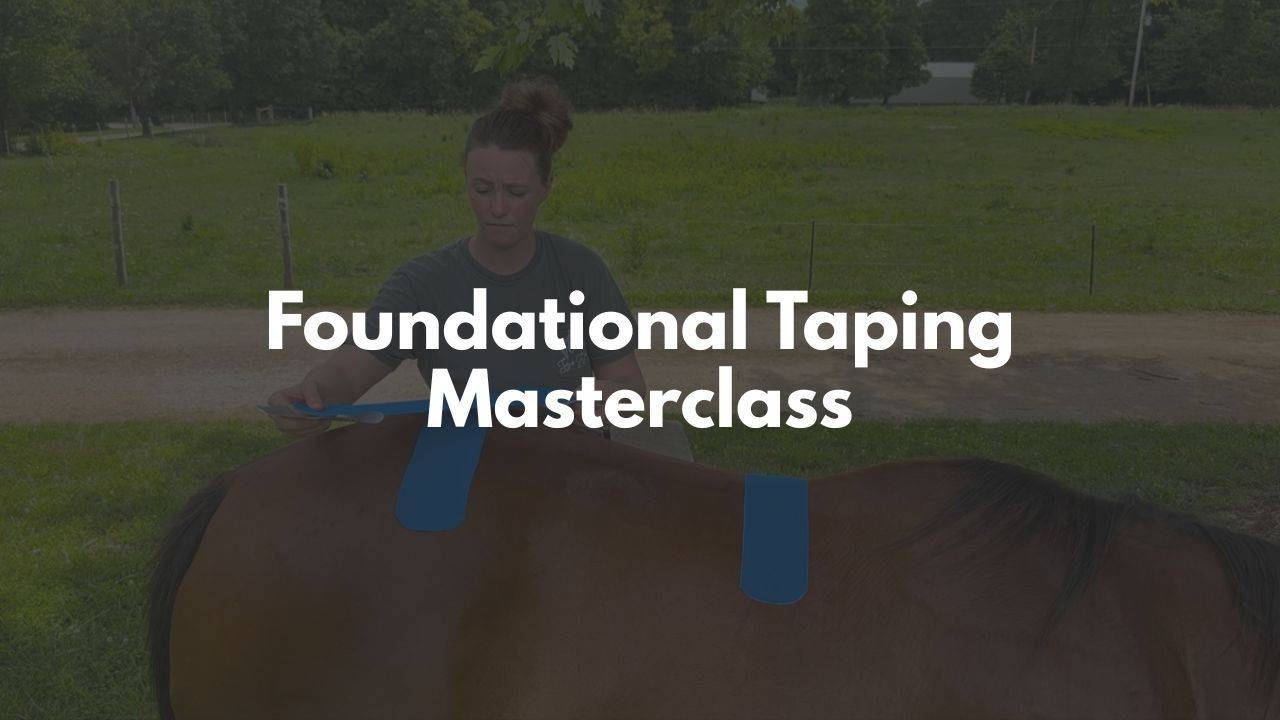
Foundational Taping Masterclass
-
Introduction
9 lessons- Welcome
- Meet The Instructor
- Terms and Conditions of Use
- Terms of Use & Copyright Agreement (Course is Locked Until Completed)
- Start Here!
- Vocabulary
- Vocabulary Quiz
- Printable Tape Manuals
- FAQ's
-
Anatomy
8 lessons- Skeleton
- Muscle Anatomy
- Muscle Anatomy Quiz
- Lymphatic System
- Vessel Decompression
- Lymphatic Quiz
- Fascia
- Fascia Quiz
-
Elastic Kinesiology Tape
5 lessons- How the Tape Works
- Tape Quiz
- Evaluation Process
- Full Body Scan
- Tape Cuts and Tears
-
Muscle Applications
22 lessons- Intro to Muscle Applications
-
Superficial Glutes
- Superficial Glutes Application
- When to Tape the Superficial Glutes
-
Biceps Femoris
- Biceps Femoris Application
- When to Tape the Biceps Femoris
-
Hamstrings
- Hamstring Application
- When to Tape the Hamstrings
-
Tensor Fascia Lata (TFL)
- Tensor Fascia Lata (TFL) Application
- When to Tape the TFL
-
Quadriceps
- Quadriceps Application
- When to Tape the Quadriceps
-
Longissimus Dorsi (Back)
- Longissimus Dorsi (Back) Application
- When to Tape the Longissimus Dorsi
-
Brachipcephalicus/Omotransversarius (Neck)
- Brachipcephalicus/Omotransversarius (Neck) Application
- When to Tape the Neck
-
Triceps/Delt
- Triceps/Delt Application
- When to Tape the Shoulders
-
External Abdominal Obliques
- External Abdominal Oblique Application
- When to Tape Exteneral Abdominal Obliques
-
Suprastinatus
- Suprastinatus Application
- When to Tape the Suprastinatus
-
Core Support
- Core Support Application
-
Circulation Applications
12 lessons- Intro to Circulation Applications
- Heat Cycle Relief
-
Coronary Band
- Circulation - Coronary Band
- When to Tape the Coronary Band
-
Hamstrings
- Circulation - Hamstrings
- When to Tape the Hamstrings
-
Lower Legs
- Circulation - Lower Leg
- When to Tape the Lower Leg
-
Knee
- Circulation - Knee
- When to Tape the Knee
-
TMJ/Masseter
- Circulation - TMJ/Masseter
- When to Tape the TMJ/Masseter
-
Fascia Applications
6 lessons- Intro to Fascia Applications
- Which Fascia Application is Best?
- Fascia Wave
- Fascia Alternating Wave
- Fascia Braid
- Fascial Lines - SDL
-
Edema Applications
4 lessons- Intro to Edema Applications
- When to Tape for Edema
- Edema
- Edema - Lower Leg
-
Spine Applications
8 lessons- Intro to Spine Applications
- Poll
- When to Tape the Poll
- Thoracic Spine
- When to Tape the Thoracic Spine
- Lumbar Spine
- Sacrum
- When to Tape the Sacrum
-
Joint Support Applications
17 lessons- Intro to Joint Support Applications
-
Fetlock
- Simple Fetlock Application
- When to use the Simple Fetlock
- When to use the Full Fetlock Support
- Fetlock and Suspensory Support
- When to use Flexor Support
- Fetlock and Flexors
- Fetlock and Extensors
- When to use Extensor Support
-
Hock
- Hock (medial and lateral)
- Hock (DIT and TMT)
- When to use Hock Support
-
Stifle
- Stifle Application
- When to use Stifle Support
-
Knee
- Knee (carpals) Application
- When to use Knee Support
- Perneous Tertius Tendon Rupture
-
Head and Neck
7 lessons- TMJ Decompression
- When to use TMJ Decompression
- When to use Trigeminal Nerve Decompression
- Trigeminal Nerve
- When to use Soft Tissue Star
- Soft Tissue Decompression
- Upper Airway Nasal Support
-
Foal Limb Deformities
8 lessons- Angular Limb Correction Paper
- Medial Deviation
- Lateral Deviation
- Over At The Knee
- Knee Hypertension
- Over At The Fetlock - Fetlock Contraction
- Dropped Fetlock / Fetlock Hypertension
- Windswept Hocks
-
Bonus: Business Module
3 lessons- Building a Business
- Using Tape in Business
- 10 Tips for Building Your Social Media
-
Research Papers
15 lessons- Core Support At A Trot
- Post Operative Stifle Swelling Management
- Post Operative Castration Edema and Pain Management
- Improved Blood Flow
- Tape Improves Balance Up to 72 Hours After Removal
- Mild Stretch for Pain Relief
- Tape Improves Balance Performance in Dancers
- Decreases Female Back Pain and Disability with Cycle
- Decreases Pain and Anxiety with Menstrual Cycle
- Relieves Pain and Improves Muscle Strength
- Decreases Post Exercise Muscle Soreness
- Useful In Preventing Ankle Sprains
- Just As Effective As Ankle Brace
- Decreases Sensitivity in Trigger Points
- Just As Effective as Dry Needling in Improving Pain and Motion
Learning Objectives
- Understand Equine Anatomical Structures Relevant to Taping
Students will be able to identify and describe key components of the equine skeletal system, major muscle groups, lymphatic pathways, and fascial lines, and explain how these anatomical structures influence movement, circulation, and tissue function.
- Explain the Principles of Fascia and Biotensegrity
Students will develop an understanding of fascia properties, fascial connectivity, and the concept of biotensegrity, and explain how these principles influence equine biomechanics, compensation patterns, and taping strategies.
- Conduct Functional Assessments to Determine Taping Needs
Students will learn to evaluate posture, movement patterns, tissue quality, and areas of restriction or dysfunction in order to determine appropriate locations and goals for kinesiology taping applications.
- Demonstrate Knowledge of Kinesiology Tape Properties and Application Techniques
Students will be able to identify different types of kinesiology tape, tape elasticity properties, adhesive characteristics, and common tape cuts (I, Y, fan, web, decompression, etc.), and explain how each affects therapeutic outcomes.
- Explain the Neurological and Sensory Effects of Kinesiology Tape
Students will understand how kinesiology tape stimulates the tactile and nervous systems, influences proprioception, and contributes to long-term tissue changes through neuromuscular feedback and improved circulation.
- Apply Targeted Taping Techniques for Muscles, Circulation, Fascia, Spine, Joints, and Head/Neck
Students will demonstrate competency in applying a comprehensive library of techniques, including:
- 11 muscle applications with clinical indications
- 7 circulation/lymphatic applications
- 3 fascial applications
- edema management techniques
- 4 spinal applications
- 10 joint stabilization applications
- 6 head and neck applications
Students will also learn when each application is most appropriate based on assessment findings.
- Implement Corrective Taping for Developmental and Limb Conditions
Students will learn to apply 7 kinesiology taping techniques designed to support foals with limb deformities, including identifying when taping may assist with alignment, proprioception, and muscular support during early development.
- Integrate Kinesiology Taping into Professional Equine Practice
Students will gain tools to incorporate kinesiology taping into their equine practice or business, including communication with clients, ethical considerations, documentation, and referencing current research literature. Students will also learn to utilize a taping field manual and supporting evidence papers to guide safe and effective practice.